The Five Automated Emails Worth Building Before Any Others
Most lifecycle programmes begin with a newsletter and stall there. Five triggered emails carry the majority of the revenue — here they are, in build order.
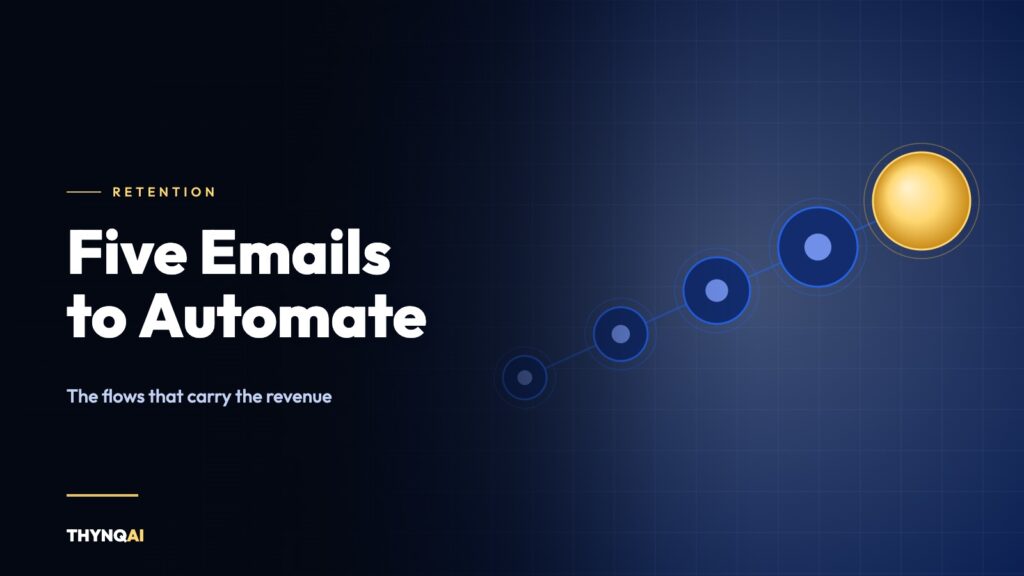
Short answer: Build these five triggered emails first, in this order: the welcome sequence, the abandoned-action recovery, the post-purchase onboarding, the replenishment or expansion prompt, and the win-back. Each fires on a customer behaviour rather than a calendar, which is why they outperform broadcast campaigns by a wide margin on nearly every account.
The common failure is not sending too few emails. It is sending them on the wrong axis. A weekly newsletter goes to everyone at once, at a moment chosen by you. A triggered email arrives at a moment chosen by the customer, which is the entire reason it works.
Why triggered beats broadcast
A triggered email fires when a person does something — signs up, abandons a basket, completes a purchase, goes quiet. A broadcast goes to a list segment on a schedule.
The difference is intent timing. A newsletter interrupts someone in the middle of their day. A basket-abandonment email arrives twenty minutes after they demonstrated interest and did not finish. The message can be less clever and still perform better, because the timing is doing the work.
Triggered flows also compound without further labour. You build the abandoned-basket sequence once and it runs on every abandonment for years. A newsletter costs the same effort every week forever. For a small team, this is the whole argument — and lifecycle flows are near the top of the list of marketing work worth automating.
1. The welcome sequence
Trigger: someone joins your list or creates an account.
Send: three to five emails over ten to fourteen days.
This is first because it is the moment of peak attention. Someone who just subscribed is more engaged with you than they will be at any other point, and most businesses answer that with a discount code and silence.
A structure that works:
| Timing | Job | |
|---|---|---|
| 1 | Immediate | Deliver what was promised. Set expectations for what comes next and how often. |
| 2 | Day 2 | The problem you solve, and why your approach differs. No pitch. |
| 3 | Day 4 | Proof — a case, a result, a customer in their situation. |
| 4 | Day 7 | Handle the biggest objection directly. Usually price or switching cost. |
| 5 | Day 11 | The offer, with a reason to act now that is honest. |
Two rules that matter more than the sequence:
- Send the first one immediately. Engagement decays sharply within hours. An hourly batch job is throwing away most of the value.
- Do not lead with the discount. It teaches people to wait for one, and it converts the segment that was going to buy anyway at a lower price.
2. Abandoned-action recovery
Trigger: a high-intent action started and not completed — a basket, a checkout, a form, a booking, a trial signup that never reached first use.
Send: three emails over 72 hours.
Most teams build this for baskets and stop. The same mechanic applies to any incomplete high-intent action, and the non-ecommerce versions are usually untouched. An abandoned demo booking or a half-finished application is exactly as recoverable as a basket.
Timing that holds up across accounts:
- 1 to 4 hours: a genuine reminder. No discount, no urgency. Many abandonments are interruptions, and a plain “you left this here” recovers a surprising share of them.
- 24 hours: address the friction. Delivery cost, returns policy, security, setup effort — whatever the actual objection is at that step.
- 48 to 72 hours: the last one. This is where an incentive belongs, if you use one at all.
The discount question deserves care. Offering one on the first email trains repeat customers to abandon deliberately. If you use an incentive, put it last, and check whether the recovered margin justifies it — a recovery rate that improves while contribution falls is not a win. Judge it against your break-even margin, not against the recovery rate on its own.
3. Post-purchase onboarding
Trigger: a completed first purchase or signup.
Send: two to four emails across the first fortnight of ownership.
The most under-built flow in most accounts, and the one with the clearest link to lifetime value. The window immediately after purchase is when a customer decides whether the thing was a good idea. Silence in that window is how you get returns, refunds and churn.
What belongs here:
- Confirmation and honest expectations — when it arrives, what happens next
- How to get the most out of it, specifically, not a generic manual link
- A nudge toward the action that predicts retention. Every business has one: second login, first invite, first integration, first reorder. Find yours and build the email around it.
- The review or referral request, once — after the value has landed, not before
This flow is also where you earn permission for everything that follows. A customer who had a good first fortnight opens the next twenty emails. One who did not marks them as spam.
4. Replenishment or expansion
Trigger: a predicted moment of renewed need.
Send: one or two emails, timed to the cycle.
For consumables, this is replenishment: work out the median repurchase interval for the product and send at roughly 80% of it. A 60-day consumable gets an email around day 48, before they run out and go looking elsewhere.
For subscription or service businesses, the same mechanic runs on usage rather than time: a customer approaching a plan limit, using a feature that indicates readiness for the next tier, or adding seats. The trigger is a behavioural threshold, not a date.
This is the highest-margin flow in most accounts because the acquisition cost was already paid and the message needs no persuasion — only good timing. It is also the one most often left unbuilt, because it requires knowing your own repurchase cycle, which requires looking.
5. Win-back
Trigger: a defined period of inactivity — usually 1.5 to 2 times the median purchase or login interval.
Send: two to three emails, then stop and suppress.
Two things to get right.
Define lapsed from your own data. Ninety days is the default because it is a round number, not because it describes your customers. If your median repurchase interval is 40 days, someone at 90 days lapsed months ago and you have missed the window. If it is 8 months, 90 days is a customer behaving normally.
Ask before you discount. A short “is this still useful to you?” email consistently earns replies and re-engagement, and costs no margin. The discount, if you send one, goes second.
Then genuinely stop. A win-back flow that never gives up quietly damages deliverability across your whole programme, because sustained low engagement teaches inbox providers to filter you. Suppressing unresponsive contacts usually improves inbox placement for everyone still listening — which means the win-back flow’s most valuable output is often the list hygiene, not the recovered customers.
The order matters
Build them in the order above, not in parallel. Each flow feeds the next: the welcome sequence determines who is engaged enough for the abandonment flow to reach the inbox, and post-purchase onboarding determines whether the replenishment prompt lands with someone who liked what they bought.
One well-built flow beats five half-built ones, and half-built flows are worse than none — a broken abandonment email that fires twice, or a win-back that reaches active customers, does measurable damage to trust.
Frequently asked questions
How many emails should a welcome sequence have?
Three to five over ten to fourteen days suits most businesses. Longer consideration cycles justify more. The test is whether each email has its own job; if two could be merged without losing anything, merge them.
When should an abandoned cart email be sent?
The first within one to four hours, a second at around 24 hours, and a third at 48 to 72 hours. The first performs best as a plain reminder without an incentive.
What is the difference between a lifecycle email and a newsletter?
A lifecycle email is triggered by an individual’s behaviour and sent to them at their own moment in the journey. A newsletter is sent to a segment on a schedule you choose. Lifecycle flows generally produce far more revenue per send.
How long should a win-back flow wait before it triggers?
Base it on your own median purchase or login interval and trigger at roughly 1.5 to 2 times that figure. The common 90-day default is arbitrary and is either far too late or far too early for most businesses.
Do automated emails hurt deliverability?
Well-targeted ones improve it, because triggered emails earn high engagement and inbox providers weight engagement heavily. What damages deliverability is continuing to send to people who never open — which is why the win-back flow must end in suppression.
ThynqAi builds lifecycle and retention systems that turn first purchases into repeat revenue. If your programme is a newsletter and an abandoned cart email, ask us for an audit.