Schema Markup Services
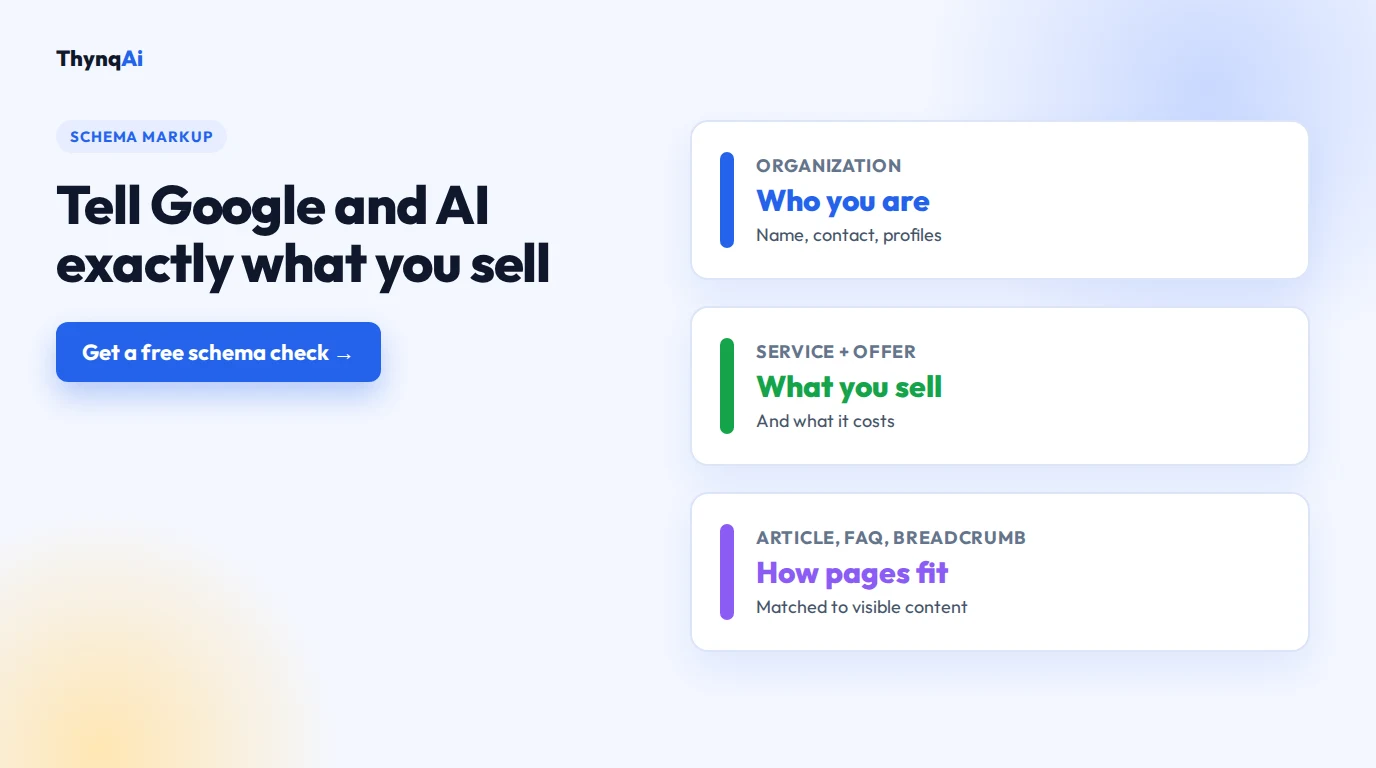
We add JSON-LD schema markup that tells Google and AI assistants who you are, what you sell, what it costs and how your pages fit together, written to match what is on the page and tested before it goes live.
Last updated 13 October 2026
Search Console totals for client properties, 27 May to 23 August 2026; Google Ads totals Q2 2019 to Q3 2026.
What schema does
Google’s structured data guide explains that structured data gives Google explicit clues about a page’s meaning and can make it eligible for rich results. For AI assistants, the same markup is a clean statement of facts: your name, services, prices and locations, in a format they do not have to guess at.
The schema types we use
| Type | Used on | What it tells engines |
|---|---|---|
| Organization / LocalBusiness | Every page | Who you are, contact details, profiles, service areas |
| Service + Offer | Service and pricing pages | What you sell and, where public, what it costs |
| BreadcrumbList | Every page | Where the page sits in your site |
| Article / BlogPosting | Blog posts | Headline, author, dates and image |
| FAQPage | Pages with visible Q&As | Questions and answers on the page |
| ItemList / CollectionPage | Hub and listing pages | Which pages belong to a section |
What changed in 2023
Google announced changes to FAQ and HowTo rich results in August 2023: FAQ rich results are now shown mainly for well-known, authoritative government and health sites, and How-to rich results were retired. We still use FAQ markup where the questions are visible, because it describes the page clearly to every engine, but we do not sell it as a way to win bigger listings.
How we add schema
- Map every page type to the schema it needs
- Write JSON-LD that matches the visible content, following Google’s structured data guidelines
- Connect entities with stable IDs, so your organisation, services and pages link together
- Test in Google’s Rich Results Test and the Schema.org validator
- Monitor Search Console enhancement reports after launch

Frequently asked questions
What is schema markup?
Schema markup is structured data, usually in JSON-LD, that tells search engines exactly what a page is about: your organisation, services, prices, articles, FAQs and breadcrumbs. Google uses it to understand pages and to show rich results.
Does schema improve rankings?
Schema is not a direct ranking boost, but it helps Google understand your pages and makes them eligible for rich results, which can improve clicks. It also helps AI assistants identify who you are and what you offer.
Do FAQ rich results still show in Google?
Rarely. Since Google’s August 2023 changes, FAQ rich results are shown mainly for well-known, authoritative government and health sites, and How-to rich results were retired. FAQ markup is still worth keeping for clarity and for other engines, but it is not a reliable way to get a bigger listing.
Which schema types does a service business need?
Usually Organization or LocalBusiness, Service with offers where prices are public, BreadcrumbList, Article for blog posts, and FAQPage where the page shows real questions and answers.
Can schema get my site penalised?
Yes, if it describes content that is not on the page, such as fake reviews or hidden FAQs. Google’s structured data guidelines require markup to match what users see.
Let's Talk
Leave your details and our team will get back to you.
- A reply within 24 hours
- A free audit of your current setup
- No obligation, no pressure