How Much Does a Performance Marketing Agency Cost? A Straight Answer
Most agencies will not put a number on a page. Here are the five pricing models, what each one really costs you, and the one that quietly rewards your agency for spending more.
Short answer: Performance marketing agencies price in five ways: flat retainer, percentage of ad spend, hourly, project fee, or performance-based. For most businesses the meaningful figure is not the fee itself but the fee expressed as a share of the profit the work produces. A retainer that looks expensive against a small budget can be cheap against the margin it generates, and a percentage-of-spend deal that looks cheap can quietly cost you the most of all.
Almost no agency publishes pricing. The reason given is that every engagement differs, which is true. The reason it persists is that a vague number is easier to defend in a sales call than a specific one. This article gives you the structure instead, so you can price any quote you receive.
The five pricing models
| Model | How it works | Best when | The catch |
|---|---|---|---|
| Flat retainer | Fixed monthly fee for a defined scope | Scope is stable and ongoing | Scope creep in either direction — you overpay in quiet months or get thin service in busy ones |
| Percentage of ad spend | Fee is a set share of media budget | Budgets are large and stable | The agency earns more when you spend more. See below |
| Hourly | Billed against time worked | Short, well-defined tasks | Rewards slowness. Nobody wants their supplier optimising for hours |
| Project fee | Fixed price for a defined deliverable | Audits, builds, migrations | Poor fit for ongoing optimisation, which has no end state |
| Performance-based | Fee tied to results — CPA, revenue share, or a bonus on top of a base | Attribution is genuinely clean | Rare in pure form, and the definition of “result” is where the argument lives |
Most real engagements are hybrids: a base retainer plus a performance element, or a retainer that steps up at defined spend thresholds.
The percentage-of-spend problem
This deserves its own section because it is the most common model and the least examined.
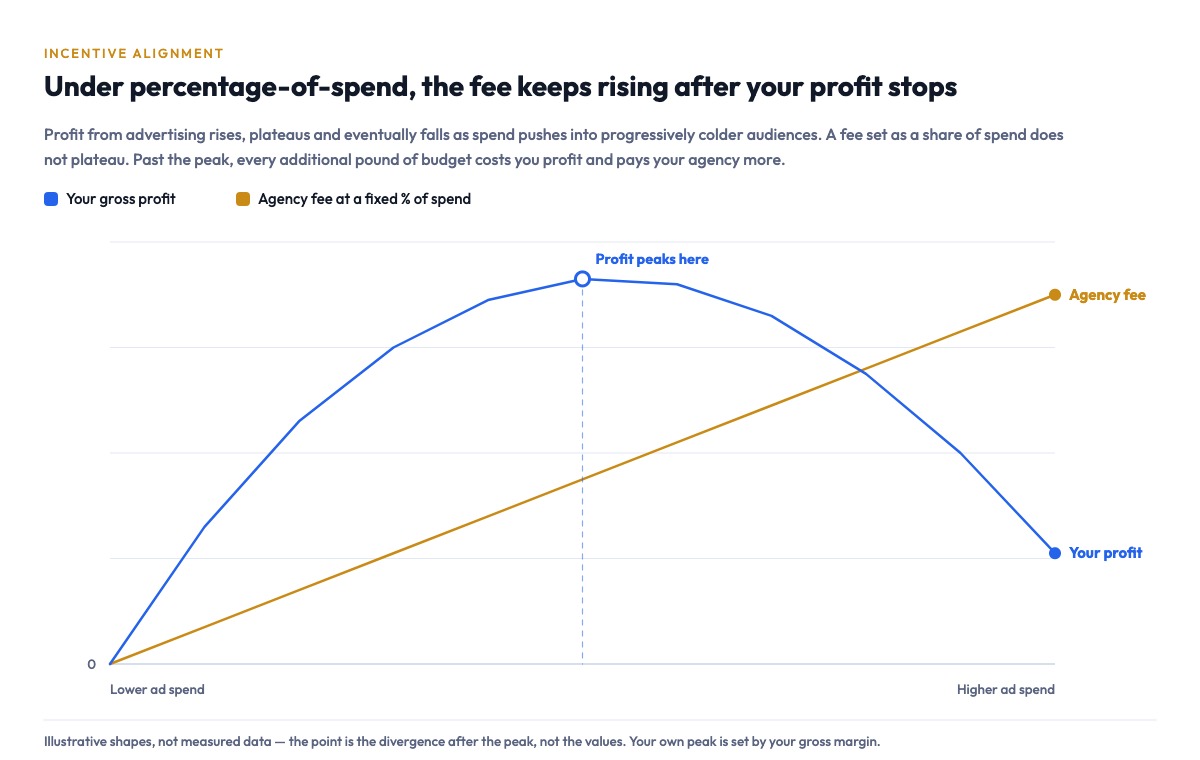
If your agency is paid a percentage of what you spend, then every recommendation to spend more is also a recommendation to pay them more. That is not an accusation of bad faith. It is a structural fact about the incentive, and structural facts outlast good intentions.
Consider what the model does at the moment of decision. Your agency finds a campaign running below your break-even ROAS. Switching it off is the right call. It also cuts their own fee. A good agency switches it off anyway — but you have arranged things so that doing the right thing costs them money, every single time.
The reverse is worse. Scaling a campaign into colder audiences lowers ROAS while potentially raising total profit. That is often correct. Under percentage-of-spend, it is also always in the agency’s interest. You now cannot easily tell a genuine scaling recommendation from a self-interested one, because both look identical.
If you use this model, two safeguards are worth insisting on:
- A fee cap in absolute terms, so the incentive flattens above a threshold
- A stated break-even assumption in writing, so scaling decisions are measured against a number you both agreed in advance rather than argued about afterwards
None of this makes percentage-of-spend indefensible. It is administratively simple and it scales with the complexity of the work, which is real. It just needs the guardrails that its own structure invites.
What actually drives the number
Fee levels vary enormously by market, seniority and scope, so treat any published range — including any you find on an agency’s own site — as a starting point for negotiation rather than a benchmark. What is stable is the list of things that move it:
- Number of channels. One channel managed properly costs far less than four managed thinly. Adding a channel adds a whole optimisation loop, not a fraction of one.
- Creative volume. Whether the agency produces creative, or only places it, is usually the single biggest line-item difference between two quotes that look similar.
- Account complexity. Catalogue size, market count, language count, and whether feeds need managing.
- Measurement burden. Clean tracking and one clear conversion is cheap. Multi-touch attribution, offline conversion imports and profit-level data cost real hours.
- Seniority of who actually does the work. The most common gap between a pitch and the reality is that the strategist who sold it never touches the account again.
- Reporting cadence. Weekly reporting to a board costs meaningfully more than a monthly dashboard.
How to compare two quotes properly
Quotes are rarely comparable as presented. Normalise them before deciding.
1. Convert everything to total annual cost. Include the fee, any setup or onboarding charge, tooling you will be asked to buy, and creative production if it is billed separately. A lower monthly fee with production billed per asset frequently ends up higher.
2. Ask what is explicitly out of scope. This is the question that changes the number most. Landing pages, creative, feed management, analytics implementation, and CRO are the usual exclusions.
3. Divide by expected gross profit, not revenue. An agency fee is only meaningfully expensive relative to the margin it produces. Work out what the engagement needs to generate at your gross margin just to cover its own cost. If you cannot get to that figure, you are not ready to hire anyone yet.
4. Price the exit. Notice period, contract length, and who owns the accounts, the pixels, the creative files and the historical data if you leave. An engagement you cannot exit cheaply is more expensive than its fee suggests, and this is where the genuinely bad deals hide.
What should be included as standard
Reasonable inclusions in any ongoing performance engagement:
- Campaign build, management and ongoing optimisation
- Audience and bidding strategy
- Conversion tracking verification — not necessarily implementation, but confirmation that what is being reported is real
- Regular reporting against agreed metrics, with definitions written down
- A named person who actually works on the account
Commonly, and legitimately, extra:
- Creative production and iteration
- Landing page design and build
- Analytics implementation or re-implementation
- Feed management for large catalogues
- Incrementality testing
The distinction that matters: anything the agency needs in order to be accountable for the result should not be optional. If conversion tracking is out of scope, nobody can be held to a number.
Red flags in a quote
- No named metric. If the engagement is not measured against something specific, there is nothing to hold anyone to.
- Guaranteed rankings or guaranteed ROAS. Nobody controls an auction or an algorithm. A guarantee is either meaningless or a sign the target has been set low enough to be trivial.
- Twelve months, no break clause. Six months is a fair minimum for compounding work. Twelve with no exit is a retention strategy, not a delivery one.
- The agency owns the ad accounts. Your accounts, your pixels, your data, your creative. Always.
- Reporting only in platform-reported figures. Platform-reported conversions and your finance system will disagree. An agency unwilling to reconcile the two is managing to the wrong number.
What to budget
Rather than a benchmark, use the arithmetic.
Work out the gross profit you need the engagement to add for it to be worth doing. Divide the annual cost of the engagement by your gross margin. That gives the incremental revenue it must produce simply to break even before any profit reaches you. Then ask honestly whether the channel, at your current scale, can plausibly produce that.
If the answer is uncomfortable, the useful conclusion is not to find a cheaper agency. It is that your budget is too small for the model, and a project-based audit or a fractional arrangement will serve you better than a thin retainer stretched across four channels. Thin coverage of everything is the most common way agency money gets wasted, and it is usually the client’s budget structure that caused it rather than the agency.
If you are budgeting for a new website alongside your campaigns, we break that down separately in how much a website costs in India, and list our typical ranges for every service on our pricing page.
Frequently asked questions
How much does a performance marketing agency cost per month?
It varies by market and scope so widely that any single figure is misleading. The useful calculation is your own: total annual cost divided by your gross margin gives the incremental revenue the engagement must produce to break even. Judge quotes against that, not against a published average.
Is percentage of ad spend a fair pricing model?
It is administratively simple and scales with workload, but it pays the agency more when you spend more, which sits awkwardly against decisions to cut or pause spend. If you use it, cap the fee in absolute terms and agree a break-even ROAS in writing.
Should I pay a marketing agency based on results?
Pure performance-based pricing is rare and usually unwise for both sides, because it depends on attribution being cleaner than it typically is. A base fee plus a performance bonus against a metric you both agree, measured in your system rather than the platform’s, is the workable version.
What should be included in a performance marketing retainer?
Campaign build and optimisation, audience and bidding strategy, verification of conversion tracking, agreed reporting, and a named person on the account. Creative production, landing pages and analytics implementation are commonly extra and should be priced explicitly.
How long should I sign an agency contract for?
Six months is a reasonable minimum, because paid media optimisation and organic work both need time to compound. Insist on a break clause and confirm in writing that you retain ownership of accounts, pixels, creative and historical data.
ThynqAi runs performance marketing measured on profit rather than platform-reported ratios, with the break-even assumption written down before anything scales. If you want a straight read on whether your current setup justifies its cost, ask us for an audit.