How to Choose a Performance Marketing Agency: The Questions That Actually Separate Them
Every agency has a deck of wins. None have a deck of the accounts that went nowhere. Here is what to ask instead, and how to run a pilot that tells you the truth.
Short answer: Judge an agency on three things: how they measure, how they are incentivised, and what you keep if you leave. Case studies, client logos and awards are selected by the agency and tell you almost nothing about what they will do with your account. The questions below are the ones where a weak answer is genuinely disqualifying.
Every pitch looks similar because every pitch is built from the same materials — the wins. Nobody presents the accounts that went sideways, which is the sample you would actually need in order to judge.
Why case studies tell you so little
Three structural problems, none of which imply dishonesty:
Survivorship. You are shown the successes. The base rate is invisible. An agency with fifty clients and three excellent results has three case studies, and so does an agency with five clients and three excellent results.
Attribution. A case study rarely separates what the agency did from what the market did. A brand that grew 60% during a category-wide surge produces a fine slide.
Selection. Good results often reflect a good starting position — a strong product, healthy margins, clean tracking. Those clients would have improved under most competent management.
None of this makes case studies worthless. Ask how the result was achieved and what would have happened without them, and a good agency will engage with the question honestly. That response tells you more than the number did.
Questions about measurement
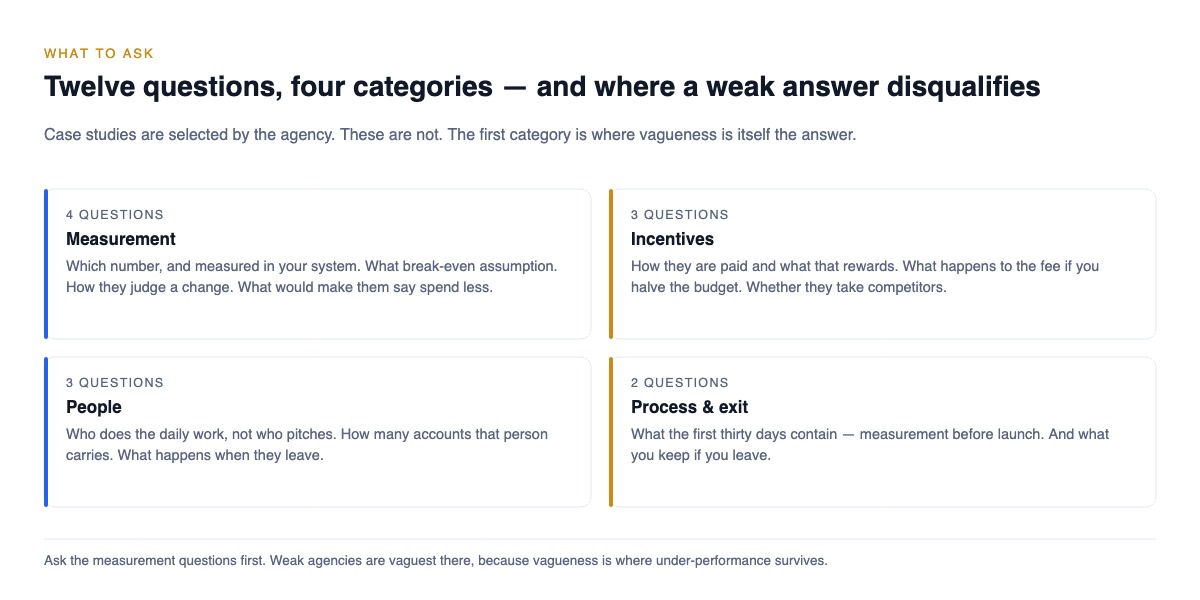
This is the highest-signal category. Weak agencies give vague answers here because vagueness is where under-performance survives.
1. Which number will you hold yourself to, and where is it measured?
Look for a specific metric measured in your system — analytics or finance — not platform-reported conversions. Platform figures and your accounts will disagree, and an agency managing to the platform’s version is managing to the flattering one.
2. What break-even assumption are you working to?
A good answer references your gross margin and produces a floor. If they cannot articulate what a good ROAS means for your business specifically, they will optimise toward a ratio rather than toward profit.
3. How will you tell whether a change worked?
Listen for whether they understand how much traffic a test needs before it can conclude anything. An agency that promises to A/B test everything on a site with modest traffic either does not understand the arithmetic or expects you not to.
4. What would make you recommend we spend less?
The most useful question in the list. Every account has campaigns that should be switched off. An agency that cannot name the conditions under which it would advise cutting spend has either not thought about it or is not incentivised to.
Questions about incentives
5. How are you paid, and what does that reward?
Not a gotcha — just get it explicit. If the fee is a percentage of ad spend, ask directly how they handle the conflict when cutting spend is correct. A good agency has a ready answer because they have been asked before.
6. What happens to your fee if we halve the budget?
Reveals the shape of the commercial relationship faster than the pricing page does.
7. Do you take clients who compete with us?
There is no single right answer. What matters is that the policy is stated rather than discovered later.
Questions about people
8. Who will actually work on this account, day to day?
The most common gap between pitch and delivery. The senior strategist in the room is frequently not the person who will open your account again. Ask to meet the actual operator.
9. How many accounts does that person carry?
An honest number tells you roughly how many hours a month you are really buying, whatever the retainer implies.
10. What happens when they leave?
Agency churn is normal. Handover process and documentation are what stop it costing you a quarter.
Questions about process and exit
11. What are the first thirty days?
A strong answer starts with auditing measurement, not launching campaigns. Anyone proposing to launch in week one without verifying tracking is planning to report numbers nobody can trust.
12. What do we keep if we leave?
Accounts, pixels, creative files, historical data, documentation. All of it should be yours, in your ownership, from day one — not transferred on exit. This is where the genuinely bad arrangements are found, and it is the cheapest question to ask.
Red flags
- Guarantees. Rankings, ROAS, lead volume. Nobody controls an auction. A guarantee means either a meaningless promise or a target set low enough to be certain.
- Reporting only in platform figures, with no reconciliation against your own system.
- The agency holding your ad accounts under their own business manager.
- No named metric in the proposal.
- Immediate discounting when you hesitate. If the price moves 30% on first resistance, it was not derived from the work.
- Answering “who does the work” with a team page rather than a name.
Green flags
- They ask about your margins before discussing budget.
- They want to see your measurement setup before quoting.
- They tell you something you did not want to hear during the pitch.
- They decline part of the scope, or say a channel is not right for you yet.
- They describe a failure, unprompted, and what it changed in how they work.
- Their proposal contains a number you would use to judge them, written down.
Run a paid pilot
Do not choose from a pitch. Buy a small, defined piece of work first — an audit, a measurement review, a single-channel sprint — and judge the actual output.
Make it a real engagement, paid at a fair rate. Free pilots produce sales effort rather than delivery, which is not the thing you are trying to evaluate.
What to watch during it:
- Did they find something you did not already know?
- Did they push back on anything, or agree with everything?
- Was the work delivered when promised?
- Is the reporting legible to someone outside marketing?
- Did they explain a trade-off, or only present upside?
A well-run pilot costs a fraction of a bad annual contract and tells you far more than three rounds of pitching.
Comparing agencies near you? We explain how we work with local businesses on our Thane page, and publish our typical prices on our pricing page.
Frequently asked questions
What questions should I ask a marketing agency before hiring them?
The highest-signal ones concern measurement and incentives: which number they will be judged on and where it is measured, what break-even assumption they are working to, what would make them recommend spending less, how they are paid, who does the daily work, and what you keep if you leave.
How do I know if a marketing agency is any good?
You largely cannot from a pitch, because pitches are built from selected wins. Buy a small paid piece of work first and judge the output — whether they found something new, whether they pushed back, and whether the reporting is honest about trade-offs.
What are the biggest red flags when choosing an agency?
Guaranteed results, reporting only in platform-reported figures, holding your ad accounts under their own ownership, no named metric in the proposal, and steep discounting at the first sign of hesitation.
Should I choose a specialist or a full-service agency?
Specialists tend to be stronger in their channel; full-service agencies coordinate across channels more easily. If one channel carries most of your spend, a specialist usually wins. If the problem spans paid, organic and conversion, coordination is worth more than depth in any single area.
How long should I give a new agency before judging results?
Paid media usually shows direction within six to eight weeks, though clean measurement takes longer. Organic and content work take months. Agree in advance what will be reviewed at thirty, sixty and ninety days.
ThynqAi will tell you during the first conversation which parts of your setup do not need us. If you want a straight assessment before you commit to anyone, ask us for an audit — or read what an engagement should cost first.