How to Get Your Brand Cited by ChatGPT, Perplexity and AI Overviews
AI assistants answer the question instead of listing links. Here is what actually decides whether your page is the source they quote — and what to change on your site this month.
Short answer: To get cited by ChatGPT, Perplexity and Google AI Overviews, put the answer in the first two sentences of each section, use your customers’ questions as headings, and keep sections short and self-contained. Add Article, Organization and visible FAQ schema, keep the page fast and server-rendered, and publish original data only you can provide.
Search stopped being a list of links. Ask ChatGPT which CRM suits a ten-person sales team, or ask Perplexity how to cut customer acquisition cost, and you get an answer — with two or three sources credited underneath. Google does the same thing at the top of its own results page.
For most businesses this changes the goal. Ranking third for a keyword used to mean traffic. Now the answer sits above the results and a large share of people never scroll. The question is no longer are we ranking but are we the source being quoted.
The good news: the work is more concrete than classic SEO, and much of it is writing and structure rather than link building.
Why AI assistants pick one source over another
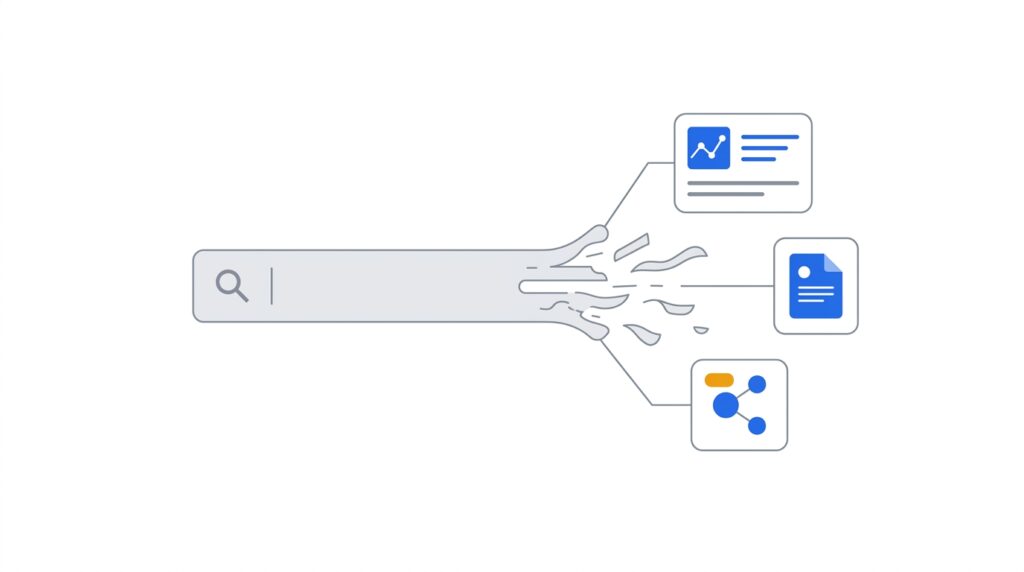
An assistant answering a question does roughly three things. It finds candidate pages, extracts passages that look like direct answers, and assembles those passages into a reply, crediting the pages it leaned on.
That middle step is the one most sites fail. A model is not reading your page the way a person browses it. It is looking for a self-contained passage that answers the question on its own. If your answer only makes sense after four paragraphs of preamble, it is a bad extraction candidate, no matter how good the article is.
This is why pages that rank well can still never get cited, and why a modest page with a clear, quotable answer sometimes beats a much bigger competitor.
Answer in the first two sentences
The single highest-value change: put the answer immediately after the question, then explain.
Most marketing content is built the other way around — context, then background, then the point. That structure is fine for a human who has already decided to read. It is close to useless for extraction.
Instead of this:
Customer acquisition cost is something every founder worries about. In this article we will explore the history of CAC, why it matters, and finally some strategies you can use…
Write this:
Customer acquisition cost is total sales and marketing spend divided by the number of new customers won in the same period. If you spent £40,000 last quarter and won 80 customers, your CAC is £500. Most teams get this wrong in one of two ways, both worth fixing before you optimise anything.
The second version can be lifted whole and still make sense. That is the entire test. Read any section of your page in isolation — if it needs the paragraph before it to be intelligible, rewrite it.
Structure the page so passages can be found
Extraction works on chunks. Give it clean ones.
- Use questions as headings. A heading reading “How much does CAC vary by channel?” matches a query far more directly than “Channel considerations”. Write headings the way your customers ask things.
- Keep sections short and complete. Roughly 150 to 300 words, each answering one thing fully.
- Front-load the specifics. Numbers, definitions, steps and named tools are what get quoted. Adjectives are not.
- Use lists for anything enumerable. Steps, criteria, comparisons. A list is trivially extractable; the same content in flowing prose often is not.
- Answer the obvious follow-up. If someone asks what CAC is, they will next ask what good looks like. Assistants reward pages that cover the cluster.
Add the machine-readable layer
Structured data does not make you rank, but it removes ambiguity about what your page contains — and ambiguity is what gets you skipped.
Worth implementing:
- FAQPage schema on any page with genuine questions and answers. The answers must be visible on the page; marking up content a visitor cannot see is against Google’s guidelines and risks a manual action.
- Article with a real author, publish date and modified date. Freshness is a live signal for assistants, which are frequently asked about current practice.
- Organization with your name, logo, and links to the profiles you control, so the assistant can connect the page to a known entity rather than an anonymous domain.
An increasingly common addition is an /llms.txt file at your root — a plain-text summary of what your site covers and where the important pages are, in the same spirit as robots.txt. Adoption is still early and it is not a ranking factor, but it costs an hour to write and makes your site cheaper to understand.
Publish things that can only come from you
Assistants are trained on and retrieve from an enormous amount of generic content. Generic content is exactly what they no longer need a source for. If your article restates what a hundred others say, there is no reason to cite you rather than any of them.
What does get cited is material that cannot be synthesised from elsewhere:
- Original data. Aggregate what you see across your own accounts. “Across 40 paid campaigns we ran last quarter, creative fatigue set in at a median of 11 days” is quotable precisely because nobody else can produce it.
- Documented method. Your actual process, with the decisions and trade-offs, not a generic five-step framework.
- Real numbers with context. A specific result, the conditions that produced it, and honestly what did not work.
- Clear definitions of contested terms. When an industry uses a phrase loosely, the page that defines it precisely becomes the reference.
This is also the most durable advantage. Structure can be copied in an afternoon. A quarter of your own data cannot.
Make the page easy to fetch
A retrieval system will give up on a page that is slow or awkward. Basic hygiene matters more than it used to:
- Server-render your content. If the main text only appears after JavaScript runs, assume some crawlers never see it.
- One
<h1>, then a sensible heading hierarchy. This is how the page gets chunked. - Real text, not text baked into images.
- Don’t gate the good part. Content behind an email form cannot be cited. Put the substance on the page and gate the tool, the template or the audit instead.
How to tell whether it is working
Traditional rank tracking will not show this. Track it directly:
- Ask the assistants. Every month, put your twenty most important customer questions to ChatGPT, Perplexity, Gemini and Google’s AI Overviews. Record whether you appear, and who does instead. Tedious, and by far the most honest signal available.
- Watch referral traffic from AI hosts. Perplexity and ChatGPT send real referrals. Segment them in analytics — the volume is usually small but the intent tends to be high.
- Watch for impressions without clicks. In Search Console, a page gaining impressions while clicks stay flat often means it is being surfaced and answered above the fold. That is a citation opportunity, not a failure.
- Track the competitor being cited instead of you. Read their page. Usually the difference is structural, and usually it is fixable.
Where to start
If you do nothing else this month:
- Take your ten highest-intent pages and rewrite the opening of each section so the answer comes first.
- Turn vague headings into the questions your customers actually ask.
- Add FAQPage schema to the pages that already have visible questions and answers.
- Publish one piece containing data only you have.
None of this is exotic. It is the same discipline good technical writing has always needed — say the thing, then explain it — applied to a reader that will not wait for your preamble.
Frequently asked questions
How do I get my brand cited by ChatGPT and Perplexity?
Put the answer in the first two sentences of each section, use the questions customers actually ask as headings, and keep sections short (150–300 words) and self-contained. Then publish material only you can provide, such as original data or your documented method.
Why does a page that ranks well never get cited by AI?
AI assistants extract passages that answer the question on their own. If your answer only makes sense after several paragraphs of preamble, it is a poor extraction candidate, however well the page ranks.
Does schema markup help with AI citations?
It does not make you rank, but it removes ambiguity about what your page contains. Use FAQPage for questions and answers that are visible on the page, Article with a real author and publish and modified dates, and Organization to connect the page to your brand.
What kind of content do AI assistants cite most?
Material that cannot be synthesised from elsewhere: original data, a documented method, real numbers with context, and precise definitions of terms your industry uses loosely.
How can I tell if AI search engines are citing my site?
Each month, put your twenty most important customer questions to ChatGPT, Perplexity, Gemini and Google’s AI Overviews and record who is cited. Also segment AI referral traffic, watch for pages gaining impressions without clicks in Search Console, and study the competitor being cited instead of you.
Where to go next
Being cited is no longer the only way into a ChatGPT answer page. Since August 2026, brands in India can also buy a labelled placement below the answer — we explain how ChatGPT Ads work in India and how they differ from earning a citation.
If the acronyms around this are still muddy, AEO, GEO and AIO explained separates the three jobs and gives you the order to tackle them in. And because these systems fan a single question out into several, the page-by-page work here only compounds once the whole subject is covered properly — which is what topic clusters do.
ThynqAi builds search and content systems for teams that need to be found by both people and machines. If you want to know how your site currently reads to an AI assistant, ask us for an audit.
Update, 4 September 2026: OpenAI released GPT-6 Astra on 3 September. We looked at what it actually changes for AI search visibility — and why the launch benchmarks do not survive independent testing.
Want this done for you? See our AI search optimisation (GEO & AIO) service or the full SEO, AEO, GEO & AIO service.