Topic Clusters vs Keyword Pages: How to Structure a Blog AI Search Can Read
One page per keyword was a strategy built for a search engine that answered one query at a time. That engine no longer exists. Here is what replaces it.
Short answer: A topic cluster is one comprehensive pillar page covering a broad subject, surrounded by focused articles that each answer one sub-question, with every cluster page linking to the pillar and the pillar linking back to each. It has replaced the one-page-per-keyword model because AI search systems expand a single query into several related ones and retrieve across all of them.
The old approach was rational for the search engine it was designed against. One query in, one ranked list out, so one page per query. That engine is gone.
What changed: query fan-out
Query fan-out is the practice of generating multiple related sub-queries from a single user question, retrieving results for each, and synthesising one answer across them. Google has described its AI features working this way — the mechanics of which sit underneath AEO, GEO and AIO — — a question about fixing a lawn triggers concurrent retrieval on herbicides, chemical-free weed removal, prevention and more, and the response is assembled from everything that comes back.
The consequence for content planning is direct: you are no longer competing for one query. You are competing to be retrievable across the whole neighbourhood of queries the system generates on its own.
A single page targeting “email deliverability” may rank respectably and still be absent from the answer, because the system fanned out to sender reputation, authentication records, list hygiene and bounce handling, and pulled its sources from wherever each of those was covered properly. A site with real coverage of all four gets retrieved four times. A site with one page gets retrieved once, if at all.
The other consequence is that long-tail keyword targeting has lost most of its value. These systems understand that “how do I stop emails going to spam”, “email deliverability best practices” and “why are my emails not being delivered” are the same question. Publishing three near-identical pages to catch three phrasings now produces three thin pages competing with each other, and reads to a quality system like scaled content.
What is a topic cluster?
Three components:
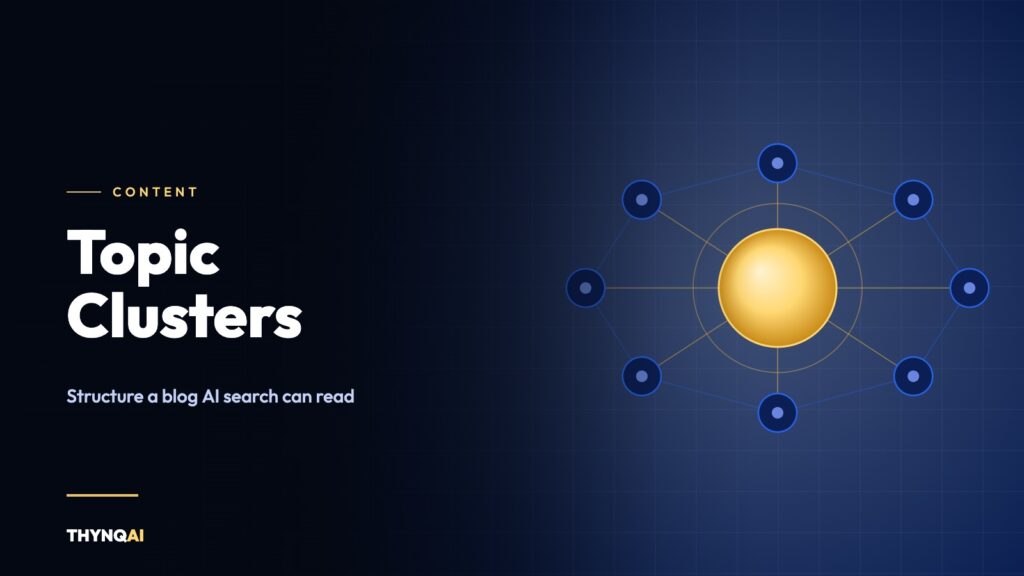
The pillar page. A thorough treatment of the broad topic — typically 2,000 to 4,000 words — that answers the parent question and introduces every sub-topic without exhausting them. It targets the head term. It is the page you would send someone who knew nothing about the subject.
The cluster pages. Focused articles, usually 1,000 to 2,000 words, each answering one sub-question completely. These target the specific questions people ask and are usually where the citations actually land, because they contain the self-contained passages.
The internal link structure. Every cluster page links to the pillar. The pillar links to every cluster page. Cluster pages link to each other where the connection is genuine. This is what tells a crawler the pages are one body of work rather than nine unrelated posts.
The structure does two jobs at once. It gives retrieval systems more surfaces to find you on, and it gives crawlers an unambiguous signal about what your site is authoritative on.
Topic clusters vs keyword pages, compared
| One page per keyword | Topic cluster | |
|---|---|---|
| Unit of planning | A search phrase | A customer question and its follow-ups |
| Handles query fan-out | Poorly — one retrieval surface | Well — multiple related surfaces |
| Internal linking | Ad hoc, often none | Structural and deliberate |
| Cannibalisation risk | High — near-duplicate pages compete | Low — each page owns one question |
| Signals topical authority | Weakly | Strongly |
| Effort per unit | Low | Higher, front-loaded on the pillar |
| Time to compound | Fast then flat | Slower then compounding |
The honest trade-off is speed. A keyword page can be published in an afternoon. A cluster is a month of planned work. The cluster wins because a keyword page’s ceiling is one query and a cluster’s ceiling rises every time you add to it.
How to build one
1. Pick a topic you can plausibly own. Not “marketing”. Something at the scale of “landing page conversion” or “paid social creative testing” — narrow enough that fifteen articles cover it substantially, broad enough that fifteen articles are warranted. If you cannot name fifteen genuine sub-questions, the topic is too narrow to be a cluster.
2. Map the fan-out yourself. Before writing anything, put the head question to ChatGPT, Perplexity and Google, and write down every sub-question that appears in the answers, the People Also Ask boxes and the related searches. Add the questions your sales team fields weekly — those are the highest-intent ones and are usually missing from keyword tools entirely. You are reconstructing the neighbourhood the retrieval system will explore.
3. Sort by intent, not volume. Group the questions into definitional (“what is”), procedural (“how to”), comparative (“X vs Y”) and evaluative (“is X worth it”, “best X for Y”). Comparison and definition formats earn a disproportionate share of AI citations, so make sure the cluster contains both rather than nine how-tos.
4. Write the pillar first, then the cluster pages. The pillar establishes scope and gives every subsequent article somewhere to link. Writing it first also exposes the sub-topics you cannot cover credibly yet.
5. Build the links as you publish. Every new cluster page links up to the pillar, and the pillar gets a new link down. Do not defer this to a tidy-up phase — it never happens, and an unlinked cluster is just a folder of posts.
6. Put your own evidence in at least three of them. Structure gets you retrieved. Originality gets you cited. A cluster where every page restates the consensus is a well-organised way of being ignored. Aggregate what you see in your own accounts, document the method you actually use, publish the number and the conditions that produced it.
How to write cluster pages that get extracted
Structure alone does not do it. Each page needs to be readable in fragments:
- Answer directly under each heading. A 40–60 word direct answer, then the explanation. If a section only makes sense after the section above it, rewrite it.
- Use the customer’s phrasing as the heading. “How much does cost per acquisition vary by channel?” beats “Channel considerations”.
- One idea per section, 150–300 words. Long enough to be complete, short enough to be one clean chunk.
- Tables for comparisons, numbered lists for processes. Both are trivially extractable. The same content in flowing prose often is not.
- Add a genuine FAQ block covering the questions too small for their own page, and mark it up with
FAQPageschema — with the answers visible on the page, since marking up hidden content breaches Google’s guidelines.
How big should a cluster be?
Around eight to fifteen pages for a first cluster: one pillar and seven to fourteen cluster pages. Below eight, the internal link structure is too sparse to signal much. Above fifteen, you are usually splitting hairs into pages that should have been sections.
Depth beats breadth by a wide margin here. Three complete clusters will outperform ten half-finished ones, because a half-finished cluster fails on exactly the fan-out queries it was built to catch. Finish one before starting the next.
How long until it works?
Expect three to six months before a new cluster contributes meaningful organic traffic, and longer for competitive topics. AI citations can appear faster — a well-structured page with original data can be quoted by ChatGPT or Perplexity within weeks of publication, because those systems draw from a wider pool than Google’s top-ranked results and weight structure and recency heavily.
Measure both. Organic sessions and rankings for the cluster’s queries, and a monthly manual check of who gets cited when you put the cluster’s questions to the assistants. The second number will move first.
Frequently asked questions
What is the difference between a topic cluster and a content hub?
They describe the same structure. “Content hub” usually emphasises the user-facing landing page that lists the collection; “topic cluster” emphasises the internal linking and topical coverage. In practice a well-built hub is a topic cluster with a good index page.
How many words should a pillar page be?
Typically 2,000 to 4,000. The real requirement is that it introduces every sub-topic in the cluster and answers the head question completely. Length is a symptom of that, not a target.
Do topic clusters still work in 2026?
More than before. Query fan-out means a system retrieves across a neighbourhood of related questions rather than matching one page to one query, which rewards comprehensive coverage of a subject and penalises isolated pages.
Should each cluster page target a different keyword?
Each should answer a different question. If two pages would answer the same question with different phrasing, they are one page. Keyword variants no longer need separate pages, because retrieval systems treat semantically equivalent queries as the same intent.
Can I turn existing blog posts into a cluster?
Usually yes, and it is generally faster than writing new ones. Group related posts, identify which head topic they orbit, write or upgrade one to serve as the pillar, then add the internal links and fill the obvious gaps. Consolidate any near-duplicates into a single stronger page and redirect the rest.
ThynqAi builds content and brand strategy designed to be found by people and machines alike. If your blog is a list of posts rather than a structure, ask us for a content audit.
Want this done for your own site? See our SEO, AEO and GEO service, or what it costs in the SEO cost in India guide.
Want this done for you? See our Our SEO audit or the full SEO, AEO, GEO & AIO service.