In-House vs Agency for Performance Marketing: The Arithmetic
Most teams compare a salary to a retainer and stop there. That comparison is wrong in three separate ways, and it usually produces the more expensive answer.
Short answer: Compare total capability cost, not salary against retainer. A single in-house marketer costs roughly 1.25 to 1.4 times their salary once employer costs are included, plus tooling, plus three to six months of ramp before they are productive — and they will still only be genuinely strong at one or two of the four disciplines performance marketing requires. An agency costs more per hour and less per capability. Which is cheaper depends entirely on how many capabilities you actually need.
The in-house versus agency debate is usually settled by whichever number is smaller on a spreadsheet with two cells in it. That spreadsheet is missing most of the cost on both sides.
What an in-house hire actually costs
Run this on your own numbers rather than trusting a benchmark:
True annual cost =
   Base salary
 + Employer taxes and benefits        (typically 15-40% of salary, by country)
 + Recruitment                        (agency fee or your own time)
 + Tooling and subscriptions          (per seat, per year)
 + Training and certification
 + Management time                    (someone senior reviews their work)
 + Ramp cost                          (3-6 months at reduced output)
Two of those lines get missed almost universally.
Management time. A mid-level marketer needs direction from someone who knows more than they do about the channel. If nobody in the business can review their work critically, you have not hired a solution — you have hired someone whose output you cannot evaluate. That is the single most expensive failure mode in the in-house route, because it can run for a year before anyone notices.
Ramp. Nobody is productive on day one. Three to six months to full output is normal, and during that period you are paying full cost for partial return. On an eighteen-month tenure, ramp is a meaningful fraction of the total.
The coverage problem
This is the part the spreadsheet cannot express.
Performance marketing is not one skill. Running it properly requires at least four:
| Discipline | What it covers |
|---|---|
| Media buying | Campaign structure, bidding, budget allocation, auction dynamics |
| Creative | Concepting, production, and reading which variants are working |
| Analytics and measurement | Tracking integrity, attribution, incrementality, profit-level reporting |
| Conversion | Landing pages, funnel diagnosis, testing discipline |
People who are genuinely strong at all four exist. They are rare, expensive, and generally not applying for a mid-level role at a company hiring its first marketer.
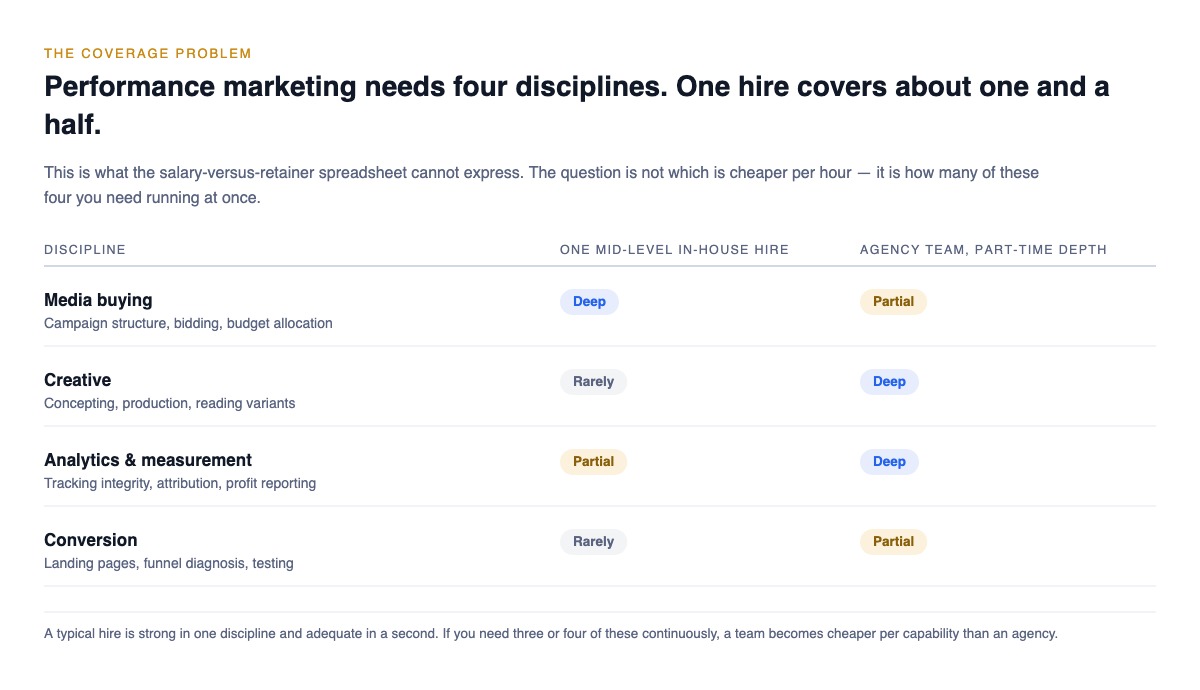
So the realistic in-house comparison is not “one marketer versus one agency”. It is one marketer who is strong at one of those four and adequate at a second, versus a team that covers all four at part-time depth. Whether that trade favours you depends on how many of the four you actually need right now — which is a question about your stage, not your budget.
When in-house genuinely wins
- One dominant channel at real scale. If eighty per cent of spend sits in one platform and the budget is large, a dedicated specialist compounds knowledge no external party will match.
- Deep product or category complexity. Long sales cycles, regulated markets, technical products where context takes months to acquire and is expensive to re-explain every quarter.
- Daily-loop creative. Businesses where creative iterates several times a week are usually badly served by an external production cycle.
- You already have senior oversight. If someone in the business can genuinely evaluate the work, in-house gets much safer.
- You are past the coverage threshold. Once you need three or more of the four disciplines full-time, a team becomes cheaper per capability than an agency.
When an agency genuinely wins
- You need several disciplines part-time. This is the common case for most businesses under a certain scale, and it is what agencies are structurally built for.
- Nobody internally can evaluate the work. An agency is accountable to a contract. A junior hire with no supervisor is accountable to nobody.
- You need to start now. Hiring takes two to four months before ramp begins. An agency starts in weeks.
- The requirement is spiky. Launches, seasonal peaks, market entries. Fixed headcount against variable need is expensive in both directions.
- You want the option to stop. A notice period is cheaper and less painful than a redundancy.
The hybrid that usually wins
For most businesses past the earliest stage, neither pure option is right. The arrangement that tends to work:
One senior in-house owner, external specialist depth.
The in-house person owns strategy, budget, brand and the relationship with the rest of the business. They do not personally execute across four disciplines. External partners provide depth in the ones that need it, and the in-house owner is senior enough to evaluate that work critically.
This resolves the two failure modes at once. The agency is not operating without informed oversight, and the in-house hire is not expected to be four people.
The mistake in the other direction is hiring the in-house owner too junior. A coordinator managing an agency is an administrative layer, not an oversight one — it adds cost without adding judgement.
The break-even calculation
Rather than debating in the abstract:
- List the disciplines you actually need over the next twelve months. Be honest about which are needed continuously and which are occasional.
- Cost the in-house route properly. Use the formula above, for however many hires genuine coverage requires. Include ramp and management time.
- Cost the agency route properly. Total annual fee including anything billed separately, using the full comparison method.
- Divide each by your gross margin to see the incremental revenue each must produce to pay for itself.
- Add the option value. How much would it cost to reverse each decision in six months? Redundancy against notice period is a real and asymmetric difference.
Two rules of thumb worth holding lightly: if you need one discipline deeply, in-house tends to win. If you need three or four at part-time depth, an agency usually wins until you are large enough to employ three or four people.
What does not change either way
Whichever route you take, these stay your responsibility:
- Owning your accounts, pixels, data and creative files. Non-negotiable in both cases, and routinely lost in the agency case.
- Knowing your break-even. Neither an employee nor an agency can be held to a target derived from margins only you know.
- Deciding what is worth automating. Reporting, alerting and QA should not consume a person’s week in either model — that is work worth automating before you hire anyone to do it manually.
The most expensive version of this decision is not choosing wrong. It is choosing either option without the measurement in place to tell whether it worked.
Frequently asked questions
Is it cheaper to hire in-house or use a marketing agency?
Per hour, in-house is usually cheaper. Per capability, an agency usually is, because performance marketing needs four distinct skills and one hire rarely covers more than two. The comparison only makes sense once both sides include tooling, ramp, management time and the cost of reversing the decision.
What does an in-house marketer really cost?
Base salary plus 15-40% in employer costs depending on country, plus recruitment, tooling, training, management time, and three to six months of reduced output while they ramp. A realistic total is meaningfully above the headline salary.
When should I hire a marketing agency instead of an employee?
When you need several disciplines at part-time depth, when nobody internally can critically evaluate the work, when you need to move faster than a hiring cycle allows, or when the requirement is seasonal rather than constant.
Can I use both an agency and an in-house team?
Yes, and for most businesses past the early stage this is the strongest arrangement: one senior in-house owner holding strategy and budget, with external specialists providing depth. It fails when the in-house owner is too junior to evaluate the external work.
How long before an in-house marketing hire pays for itself?
Allow three to six months of ramp before full output, then measure against the incremental gross profit needed to cover their true annual cost. Judging a new hire on results inside the first quarter measures your onboarding, not their ability.
ThynqAi works alongside in-house teams as often as we replace them, and we will tell you which one your situation calls for. If you want that read before you commit to a hire, ask us for an audit.