GPT-6 Astra and AI Search: What Actually Changed for SEO
OpenAI's GPT-6 Astra launched on 3 September 2026. Independent testing tells a different story to the launch benchmarks. Here is what it changes for SEO, AEO, GEO and AIO — and what it does not.
Short answer: GPT-6 Astra, released 3 September 2026, is OpenAI’s most capable model at using software — filling forms, driving browsers, completing multi-step work. It does not, on its own, change how ChatGPT chooses which websites to cite. The visibility shift to prepare for is agentic, not editorial.
That distinction matters, because most of what has been published this week conflates the two.
What GPT-6 Astra actually is
OpenAI released GPT-6 Astra on 3 September 2026, rolling out in stages to ChatGPT Plus, Pro, Business and Enterprise, plus the API, Microsoft Azure and AWS Bedrock. Sam Altman apologised publicly for a “messy rollout” after Pro subscribers found they were not first in line.
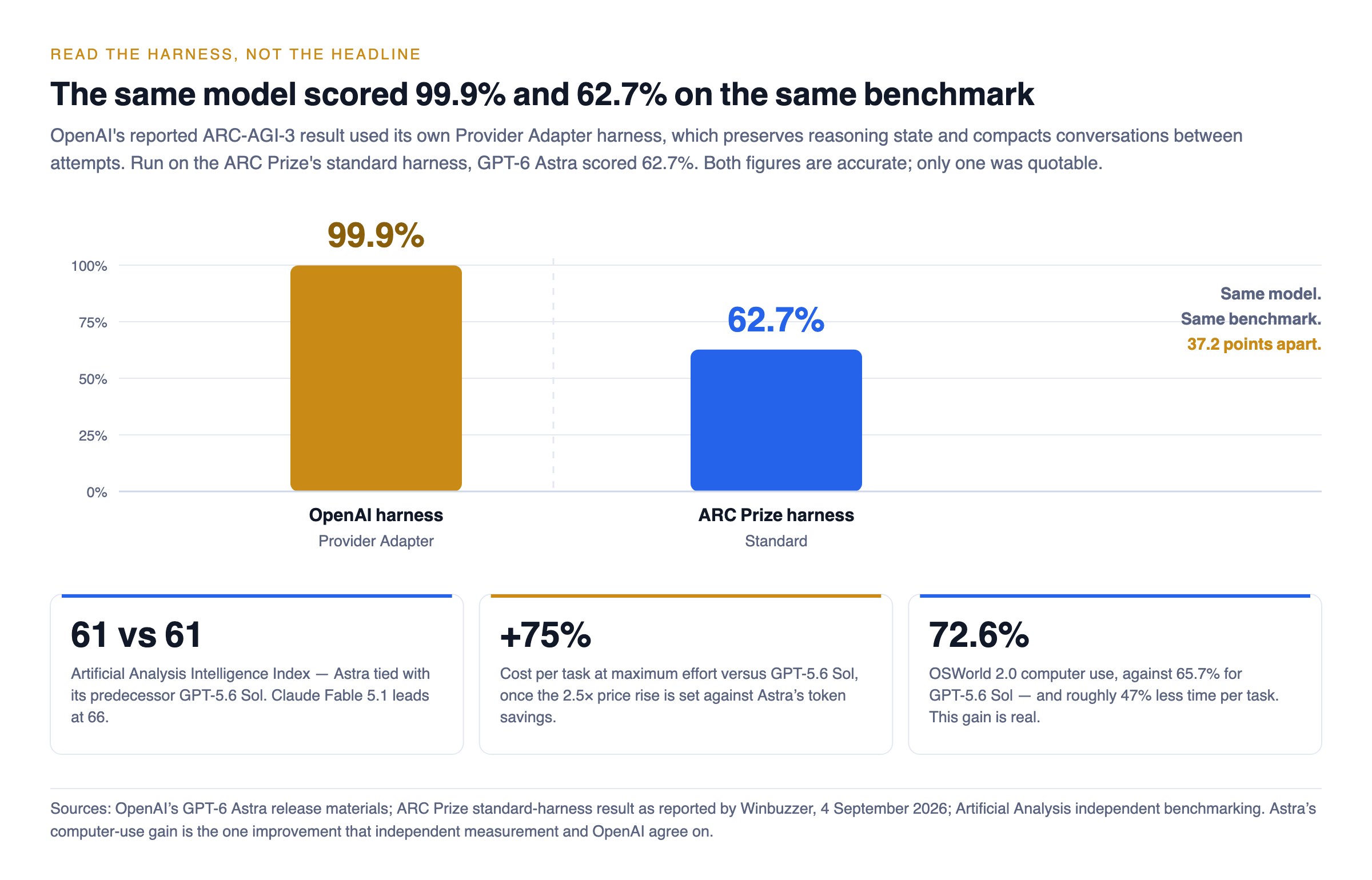
The headline capability is computer use. On OSWorld 2.0, OpenAI reports Astra completing 72.6% of tasks at roughly 40 minutes each, against 65.7% at roughly 75 minutes for GPT-5.6 Sol — about 47% less time per task.
API pricing is $10 per million input tokens and $50 per million output tokens, up from $4/$20. That is a 2.5× increase.
OpenAI president Greg Brockman told Axios, “I think it might be about this model,” and signed off with “Welcome to the AGI era.”
The benchmark gap nobody put in the headline
Here is where a marketing team should slow down.
OpenAI reported Astra scoring 99.9% on ARC-AGI-3. That figure came from OpenAI’s own Provider Adapter harness, which preserves reasoning state and compacts conversations between attempts. Run on the ARC Prize’s standard harness, Astra scored 62.7%.
Both numbers are real. They measure different things. Only one of them made the headlines.
Independent evaluation from Artificial Analysis found a similar pattern:
- Intelligence Index: Astra and GPT-5.6 Sol are tied at 61. Claude Fable 5.1 leads at 66.
- Coding Agent Index: Astra 67, roughly level with Claude Opus 5. Fable 5.1 leads at 70.
- Cost per task: Astra is about 75% more expensive per task than its predecessor at maximum effort, because the 2.5× price rise outweighs its token savings.
Astra is genuinely more token-efficient — roughly a third of Sol’s tokens on coding tasks. It is also more expensive to run. Both are true.
Artificial Analysis also flagged that confidence intervals were not disclosed for most comparisons, and that the composite weighting in OpenAI’s materials was stated inconsistently.
The takeaway for marketers: a vendor-run benchmark is a marketing asset. Treat it like one. When a client asks whether they should panic about Astra, the honest answer starts with “which harness?”
So does Astra change how AI search cites you?
Not directly, and this is the most common error in this week’s coverage.
Which sources ChatGPT retrieves and cites is governed by its search product — the retrieval index, the ranking layer, the citation UI — not by the weights of the underlying model. Swapping the model that writes the summary does not rewrite the rules about whose page gets pulled in. If you want the mechanics of that, we set them out in how to get cited by AI search.
Nothing in OpenAI’s Astra materials describes a change to search, browsing or citation behaviour.
If your organic traffic moves this month, look first at Google’s August 2026 spam update, which we covered separately, and at normal seasonality. Do not attribute it to Astra without evidence.
What does change: agents that use your website
Astra’s real shift is that AI agents get meaningfully better at operating software on a person’s behalf. That includes your website.
An agent evaluating you does not read your page the way a person does. It works through some combination of:
- rendered pixels — screenshotting and reading the page
- the DOM — parsing your HTML directly
- the accessibility tree — the same semantic layer a screen reader uses: headings, labels, roles, landmarks, alt text
Which means the things that make a site usable by assistive technology are now the same things that make it legible to a buying agent. Accessibility stopped being purely an ethics-and-compliance line item and became a discovery channel.
Concretely, an agent will skip you if:
- your pricing is behind “contact sales” or only renders after four JavaScript frameworks finish loading
- your buttons are unlabelled
divs - your key specifications live only inside an image or a PDF
- your headings are styled text rather than real
h2/h3elements
None of that is new advice. What is new is the cost of ignoring it.
Which acronym does Astra actually move?
| What it means | Does Astra change it? | |
|---|---|---|
| SEO | Ranking in classic search results | No |
| AEO | Being the extracted answer | No — extraction is a product behaviour |
| GEO | Being cited inside generated answers | No — citation is a retrieval decision |
| AIO | Being usable by AI systems and agents end-to-end | Yes — this is the one |
If you want the fuller definitions, we broke down AEO, GEO and AIO here. And if you are building the content layer underneath all of it, topic clusters for AI search is the structural piece.
Most agencies will sell you an “Astra readiness audit” this month. What they will actually be selling you is AIO work, which was worth doing in August and will be worth doing in October.
What to do this month
- Open your own pricing page with JavaScript disabled. If it is blank, an agent sees blank. Fix that before anything else.
- Publish a plain
/pricing.md. Tiers, prices, limits, what is included. Agents parse markdown trivially; they parse your React pricing table badly. - Run an accessibility pass on your highest-intent pages. Real headings, labelled controls, alt text on anything carrying meaning. This is AIO work wearing different clothes.
- Check your robots.txt allows the search-and-cite bots — GPTBot, OAI-SearchBot, ChatGPT-User, ClaudeBot, PerplexityBot, Google-Extended. Blocking them means those systems cannot cite you at all.
- Add dates and named authors to your best pages. Recency and attribution both weigh in citation selection.
- Stop attributing traffic changes to model launches until you have checked the algorithm updates and the seasonality.
What not to do
Do not rewrite your content library “for Astra.” Google’s own guidance is explicit that writing separate content for AI systems risks its scaled content abuse policy, and that you should not chop pages into fragments for machines. The content that earns citations is the content that would earn a human’s trust: specific, sourced, dated, and written by someone who has actually done the work.
There is one more reason for restraint. OpenAI classified Astra as meeting its Critical cybersecurity capability threshold — a model able to find and build working zero-day exploits against hardened systems without human help. Access to its advanced cyber capability is deliberately staged. A model that capable, released that carefully, is not a model whose downstream product behaviour is settled. Building a content strategy on week-one assumptions is how you end up rebuilding it in November.
One related change since Astra launched: ChatGPT now carries ads in India for Free and Go users. They sit below the answer and do not influence it, so citations still have to be earned — see ChatGPT Ads in India: what is live and who should test it.
Frequently asked questions
Does GPT-6 Astra change how ChatGPT picks sources to cite?
No. Source selection is handled by ChatGPT’s search and retrieval layer, not the language model. OpenAI’s Astra materials describe no change to search, browsing or citation behaviour.
Is GPT-6 Astra actually AGI?
OpenAI president Greg Brockman said “I think it might be about this model.” Independent measurement is less dramatic: Artificial Analysis puts Astra level with GPT-5.6 Sol at 61 on its Intelligence Index, behind Claude Fable 5.1 at 66.
Why do Astra’s benchmark scores differ so much between sources?
Harness configuration. OpenAI’s reported 99.9% on ARC-AGI-3 used its own Provider Adapter harness, which preserves reasoning state between attempts. The ARC Prize standard harness produced 62.7% for the same model.
How much does GPT-6 Astra cost?
$10 per million input tokens and $50 per million output tokens through the API — 2.5× the previous $4/$20. Fast mode costs double the standard price for up to twice the speed.
Should I change my SEO strategy because of Astra?
Not your SEO strategy. Your AIO work — making your site machine-legible for agents — is where the pressure has genuinely increased. Everything else was already true last month.
Sources and method
Written 4 September 2026. Figures verified against OpenAI’s own release materials, Artificial Analysis’s independent benchmarking, and reporting from Axios and Winbuzzer. We will update this page as OpenAI publishes more about Astra’s deployment.
If you want someone to run the agent-legibility pass on your site rather than doing it yourself, that is the kind of work we do — and here are the questions we would expect you to ask us first.
Want this done for your own site? See our SEO, AEO and GEO service, or what it costs in the SEO cost in India guide.